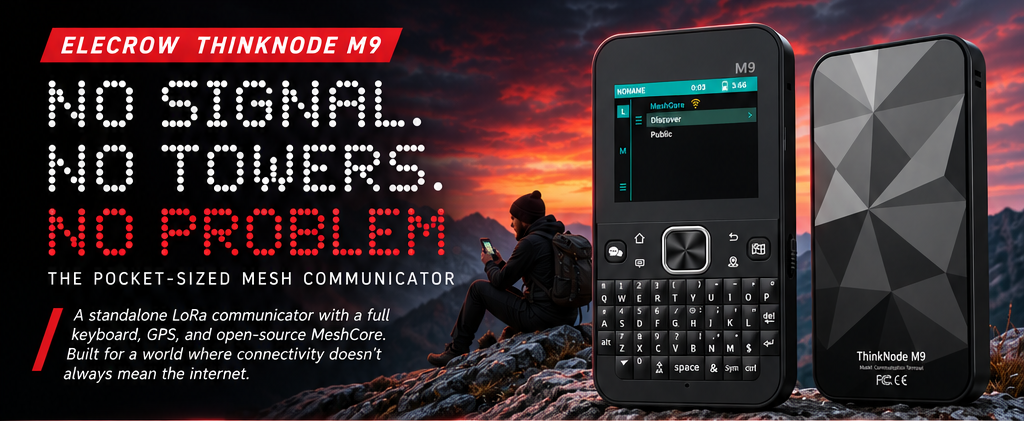
No signal. No towers. No problem. That is the pitch for the Elecrow ThinkNode M9, a pocket-sized MeshCore communicator that has its own screen and its own keyboard, so there is no phone to pair and no app to open before you can send a message.
I have been using one, and overall my thoughts are positive. Here is what Elecrow puts in the box, how it holds up next to the LilyGO T-Deck Plus, and the few things I would change.
The quick rundown
The M9 pairs an ESP32-S3 with a Semtech LR1110 LoRa radio, a 2.4 inch color display, GNSS and a 37 key QWERTY keyboard, all in a body that is about the size of a phone.

- Brain: ESP32-S3R8, dual core, up to 240 MHz, with 8 MB PSRAM
- Radio: Semtech LR1110 LoRa in 915 MHz or 868 MHz versions, plus 2.4 GHz Wi-Fi and Bluetooth 5.0 LE
- Input: 37 key physical QWERTY keyboard with a hidden reset key
- Screen: 2.4 inch TFT, 240 x 320, no touch
- Positioning: GPS, Galileo, GLONASS and BeiDou, plus a magnetic compass
- Battery: 2300 mAh, rated by Elecrow for 2 to 3 days of standby
- Charging and flashing: USB-C
MeshCore, pre-installed
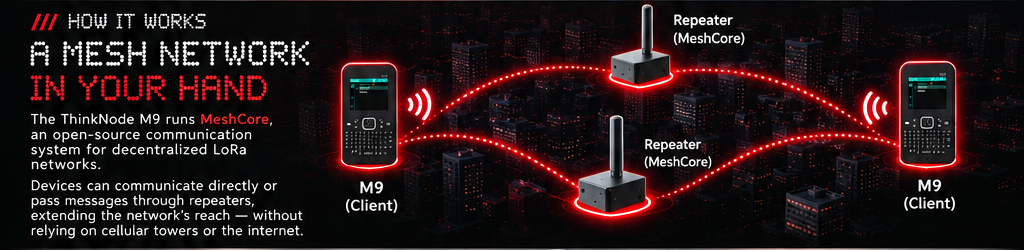
The M9 ships with MeshCore firmware already on it, so it joins a mesh as soon as it powers up. MeshCore leans on a network of clients and dedicated repeaters, which is a different approach from the flood-style routing most of us know from Meshtastic. Note that Elecrow sells the Meshtastic and MeshCore versions as separate products.
Pairing it with CAIRN
The stock MeshCore firmware works fine, but pairing the M9 with CAIRN firmware is a match made in heaven. CAIRN is a custom fork of MeshCore's companion firmware that adds a key-driven interface and extras like offline maps, spectrum scanning, repeater admin, contact QR codes and a file manager. The M9 is listed as beta support, so expect some rough edges, and a couple of features such as the music player and voice recorder are not available on it. Everything still works with the official MeshCore apps.
Since it is an ESP32-S3 with USB-C flashing, Elecrow lists support for Arduino IDE, ESP-IDF, MicroPython, C/C++ and LVGL. That makes it interesting for anyone who likes to tinker or run custom firmware.
Where it fits
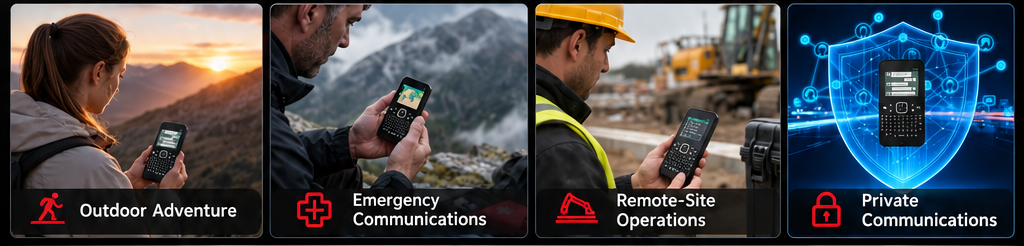
Elecrow markets it for hiking, emergency communication, convoys and remote sites, and for private group chats that stay off the cell network.
What I like
Next to the LilyGO T-Deck Plus, the M9 is very impressive. The slimness is what makes it great. Packing a keyboard, screen, GPS, LoRa radio and battery into a body about 10 mm thick is a real accomplishment, and it reminds me of the iPhone 4 series. It slips into a pocket in a way the T-Deck Plus never will.
Battery life is pretty good too. Running CAIRN, it lasts a few days, and on power save mode I get about a week out of a charge. That is better than the 2 to 3 days of standby Elecrow quotes.
What I would change
I do have a few gripes, and they are worth knowing about before you buy.
- The microSD card is internal: it is not meant to be replaced by the user. That matters because Elecrow acknowledged a worm on the cards in some early batches, including batch one. It targets Windows, and Elecrow offers a replacement unit or a reformat guide. I have a batch 2 unit, and since I run Mac and Linux it was never a concern for me, but check which batch you are buying.
- Sticky O and P keys: when I press just the O key, the P key tends to register too, so I sometimes have to go back and erase the extra P.
- Loose bezel: the frame in the center of the device, around the buttons, is very loose and the build quality is not great. Pressing a bottom corner on either side ends up pushing the Maps or Messages button.
Full hardware specs
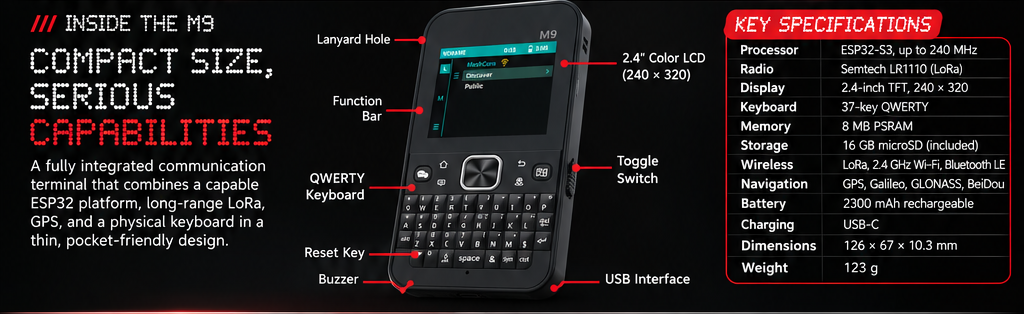
- Storage: 16 GB built in, plus 512 KB SRAM and 384 KB ROM
- Operating range: -10 to 60 °C
- In the box: the M9, a USB cable and a starter card
- Price: listed at $74.90 USD at the time of writing
Two more things to keep in mind. Real world range depends on having compatible devices or repeaters nearby, and the battery numbers are the manufacturer's estimate. Wi-Fi extras like automatic map download also need a separate license from a third-party link.
Want the full details or to grab one yourself? Check out the product page on Elecrow, and look into the batch notes above first.
View on Elecrow.com